This firm specializes particularly in work visa applications (for example, Engineer/Specialist in Humanities/International Services visas)!
**Work Visa Application:
• You have graduated from a Japanese university and have found a job, but you don’t know how to change your residence status.
• You want to hire a foreign staff member who can speak Japanese and serve customers at your store (or company) in both Japanese and their native language, but you don’t know how to handle the visa procedures.
Aren’t you facing such problems? An experienced certified visa application agent will fully support you until your permit is approved!


・While the documents required for the application are indicated by the Immigration Bureau, simply gathering and submitting them is sufficient. For example, if the applicant prepares a statement of reason for the application and the employer prepares a statement of reason for employment, the chances of approval increase. In extreme cases, such as individuals who have a history of accidental overstays, the number of documents necessary to overcome the difficulty is yet bigger. I will carefully provide guidance on this and lead you toward approval.
・If you prepare the application entirely on your own, you may encounter many unclear points. In such cases, even if you try to call the Immigration Bureau to consult an inspector, it could take several hours in extreme cases. “Time is money.” By entrusting everything to me, you can significantly reduce the time burden.
・Submitting applications at the Immigration Bureau or online takes a considerable amount of time. In particular, although the fee for revenue stamps is cheaper after approval for online applications, it can be quite cumbersome if you are not accustomed to it. Issues such as forgetting the 30-minute automatic timeout, which causes all the painstakingly entered data to be lost, or struggling to create 40MB attachment files, can be avoided.
This is an important first step in determining which status applies. For example, if someone is hired with the title of “Assistant Manager,” it is necessary to understand whether they will be deeply involved in the management of the store or employed as a leader among the sales staff, in order to determine whether it corresponds to “Business Manager” or “Engineer/Specialist in Humanities/International Services.” In cases that require particular attention, I will consult with the inspector to make an accurate assessment.
・Collecting Required Documents for the Application
For example, when applying for an Engineer/Specialist in Humanities/International Services visa, one of the required documents is a certificate of the company or store’s registration. This firm is equipped to obtain this online. Other documents that the applicant needs to prepare (such as a graduation certificate) or that the company/store needs to prepare (such as copies of financial statements) will be properly guided according to the requirements for the residence status.
・Preparation of Application Documents
Once the documents mentioned in the previous step are gathered, I will prepare the documents to be submitted to the Immigration Bureau based on the information from the hearing and other relevant information. Unless there are special circumstances, the application process will proceed online.
・Filing Application Documents
The application is generally filed online. The online method is cheaper for the issuance fee after approval. Online applications can be stressful if you are not familiar with the process. Since I already have experience with this, you can rely upon me with confidence.
・Receiving After Approval
If a Certificate of Eligibility or Residence Card is issued, I will receive it and later hand it over to the applicant responsibly.
Specific application details for a ‘work visa’:
**When having someone hired from overseas come to Japan:
You need to apply for a ‘Certificate of Eligibility.’ In simple terms, this is a certificate required for the applicant to obtain a work visa at the Japanese embassy in their country of residence. The general process is as follows:
| * A Japanese company or store decides to employ someone currently living abroad. |
| ↓ |
| * After a hearing, I take on the case, prepare the application documents, and submit the application. |
| ↓ |
| * Screen by the Immigration Bureau. |
| ↓ |
| * Approval and issuance of the Certificate of Eligibility. |
| ↓ |
| *Send the Certificate of Eligibility to the applicant. |
| ↓ |
| * The applicant applies for and obtains a work visa at the Japanese embassy in their country. |
| ↓ |
| * Arrival in Japan. A residence card is issued upon entry. |
| ↓ |
| * Start working. |
The new certificate of eligibility
↓
Is a “work visa” for working and living freely in Japan?
↓
Unable to prove 10 years of experience:
↓
**If you find employment after graduating from a university or other institution in Japan:
You need to apply for a change of status. It can also be referred to as a ‘visa switch.’ The general process is as follows:
| * A Japanese company or store decides to employ an international student who is expected to graduate or has already graduated. |
| ↓ |
| * After a hearing, I take on the case, prepare the application documents and submit the application. |
| ↓ |
| * Screen by the Immigration Bureau. |
| ↓ |
| * Approval and issuance of a new residence card. |
| ↓ |
| *Send the new residence card to the applicant. |
| ↓ |
| * Start working. |
**If changing jobs within Japan:
For example, some people mistakenly believe that if Company A, where they have been working under the “Engineer/Specialist in Humanities/International Services” status, goes bankrupt and they transfer to Company B with exactly the same business, they don’t need to do anything as long as the status is the same.
However, due to slight differences in understanding between the employer and the employee, there is a possibility, however small, that it might be impossible to work at the new company with the previous residence status.
Currently, the Immigration Bureau issues a “Certificate of Eligibility for Employment,” which allows specific confirmation of the content of activities, so obtaining this certificate is recommended for safety.
Additionally, after changing jobs, you must submit notifications such as the ‘Notification of the Contracting Organization’ to the Immigration Bureau within 14 days of the occurrence of the reporting event.
Furthermore, if you obtain the Certificate of Eligibility for Employment, you won’t need to prove eligibility for the status during the next residence period renewal, which can reduce the burden.
If you take a job that requires a completely different residence status, you will need to apply for a change of residence status.
**In case your current work visa expires:
You need apply for an extension of period of stay, which can also be referred to as a “visa extension.” In this case, it is possible to obtain permission for a longer period of stay than your current one through an explanation provided in a statement of reasons from the applicant and a statement from the employer. Ultimately, the determination of the period of stay is at the discretion of the Minister of Justice, but if you wish for the maximum period of stay (for example, 5 years for the “Engineer/Specialist in Humanities/International Services” category), I will make every effort to achieve this on your behalf. The general process is as follows:
| * The Japanese company or store decides to extend the employment of a foreign national employee or staff member. |
| ↓ |
| * After a hearing, I take on the case. I prepare the application documents and submit the application. |
| ↓ |
| * Screen by the Immigration Bureau. |
| ↓ |
| * Approval and issuance of a new residence card. |
| ↓ |
| *Send the new residence card to the applicant. |
| ↓ |
| * Continuation of employment. |
If you wish to engage in side jobs or activities that are not permitted under your current status:
For example, if you are working under a status such as Engineer/Specialist in Humanities/International Services and additionally wish to teach your native language at a language school or similar, you need ‘Permission to Engage in Activities Other Than That Permitted under Your Current Status .’ There are two types of this permission: ‘General Permission’ and ‘Individual Permission.’
If a person with an Engineer/Specialist in Humanities/International Services status wishes to teach their native language at a language school or similar, ‘Individual Permission’ is required. This is permission obtained by specifying the workplace and type of work individually, and unlike the permission needed for students (i.e., General Permission), it does not have uniform restrictions such as a maximum of 28 hours per week.
- Official:
Activities of a person who engages in official service for a foreign government or international organization recognized by the Japanese government, or that person’s family member who belongs to the same household (excluding those related to the Diplomat visa).
Period of stay: 5 years, 3 years, 1 year, 3 months, 30 days or 15 days
2. Professor:
Activities of research, research guidance, or education at a university, an equivalent institution to a university or a technical college in Japan. An example of this is a university professor.
Period of stay: 5 years, 3 years, 1 year or 3 months
3. Art:
Income-generating activities in the fields of music, art, literature, and other artistic fields (excluding those related to the Entertainer visa). Examples are composers, painters, and writers.
Period of stay: 5 years, 3 years, 1 year or 3 months
4. Religious Activities:
Missionary works and other religious activities conducted by religious personnel dispatched to Japan by foreign religious organizations. Examples are missionaries sent by foreign religious organizations.
Period of stay: 5 years, 3 years, 1 year or 3 months
5. Journalism:
News gathering and other journalistic activities conducted under a contract with a foreign media organization. Examples are reporters and photographers from foreign media outlets.
Period of stay: 5 years, 3 years, 1 year or 3 months
6. Highly Skilled Professional (a Point System for Highly Skilled Professional):
- The “Highly Skilled Professional No. 1”:
This visa was established for relaxed activity restrictions compared to other general work visas in order to further promote the acceptance of foreign nationals with highly specialized skills who are expected to contribute to academic research and economic development in Japan.
Whether to grant “Highly Skilled Professional No. 1” is based on the points system for highly skilled professionals. Points are assigned to each item, such as educational background, work history, and annual income, and permission is granted to those who reach a certain total score.
- The “Highly Skilled Professional (ii)” :
This visa is for accepting foreign nationals with highly specialized skills who are expected to contribute to academic research and economic development in Japan. This visa is for those who have stayed in Japan for a certain period of time with the “Highly Skilled Professional (i)”, and has an indefinite period of stay and significantly relaxed activity restrictions.
Those eligible for “Highly Skilled Professional No. 2” are as follows:
Among these foreigners, a points system for highly skilled personnel is used, in which points are assigned to each category such as educational background, work history, and annual income, and permission is granted to those who have reached a certain total number of points.
7. Business Administration:
Activities such as trade or other businesses or the management of these (except for operating or managing businesses that cannot be conducted by law without the qualifications listed in the section on legal and accounting services in Appended Table 1-2 of the Immigration Control Act). Examples are company managers and administrators.
Period of stay: 5 years, 3 years, 1 year, 6 months, 4 months or 3 months
8. Legal/Accounting Services:
To engage in a legal or accounting work that must be performed by foreign legal consultants, foreign certified public accountants, or other legally qualified persons. Examples are lawyers and certified public accountants.
Period of stay: 5 years, 3 years, 1 year or 3 months
9. Medical Services:
For medical care performed by doctors, dentists, and other legally qualified persons.
Period of stay: 5 years, 3 years, 1 year or 3 months
10. Researcher:
For research works based on a contract with a public or private institution in Japan (except for activities listed under “Professor” in Appended Table 1-1 of the Immigration Control Act). Examples are researchers at government agencies and private companies.
Period of stay: 5 years, 3 years, 1 year or 3 months
11. Instructor:
Activities such as language education or other education at an elementary school, junior high school, compulsory education school, senior high school, secondary education school, special needs school, vocational school, miscellaneous school, or educational institution equivalent in terms of facilities and organization in Japan. Examples are language teachers at junior high and high schools.
Period of stay: 5 years, 3 years, 1 year or 3 months]
12. Engineer/Specialist in Humanities/International Services:
For activities which require skills or knowledge in the fields of science, engineering, or other natural sciences, or in the fields of jurisprudence, economics, sociology, or other humanities, or work that requires thinking or sensibilities based on a foreign culture, conducted based on a contract with a public or private organization in Japan (except for activities listed in the “Professor,” “Artist,” and “Journalist” sections of Table 1 of Appended Table 1 of the Immigration Control Act, and activities listed in the “Business Administration,” “Legal/Accounting Services,” “Medical Services,” “Research,” “Education,” “Intra-company Transferee,” “Nursing Care,” and “Entertainment” sections of Table 2). Examples are mechanical engineers, interpreters, designers, language teachers in private companies, and marketing professionals.
Period of stay: 5 years, 3 years, 1 year or 3 months
13. Intra-company Transferee:
An employee of a foreign office of a public or private organization with a head office, branch office, or other business office in Japan is transferred to a business office in Japan for a fixed period of time and engages in activities listed in the section on Engineers/Specialist in Humanities/International Services in Appendix 1-2 of the Immigration Control Act at said business office. An example of this is a transferee from a foreign business establishment.
Period of stay: 5 years, 3 years, 1 year or 3 months
14. Nursing Care:
For a person with a care worker qualification to engage in caregiving or care guidance work based on a contract with a public or private institution in Japan. An example of this is a certified care worker.
*The ordinance on landing criteria for the “care worker” status was revised on April 1, 2020, and the Nursing Care visa will now be granted regardless of the route taken to obtain the care worker qualification.
Period of stay: 5 years, 3 years, 1 year or 3 months
15. Entertainer:
Activities such as theatrical performances, performing arts, musical performances, sports, etc., or other entertainment activities (except for activities listed in the business management section of Appended Table 1-2 of the Immigration Control Act). Examples are actors, singers, dancers, and professional athletes.
Period of stay: 3 years, 1 year, 6 months, 3 months or 30 days
16. Skilled Worker:
For works which require skilled techniques in a specific industrial field, based on a contract with a public or private organization in Japan. Examples are chefs of foreign cuisine, sports instructors, aircraft pilots, and craftsmen who process precious metals.
Period of stay: 5 years, 3 years, 1 year or 3 months
17. Special Skilled Worker:
There are 2 categories:
*Special Skill #1:
Works which require skills requiring a considerable degree of knowledge or experience as defined by Ministry of Justice ordinance, in specific industrial fields designated by the Minister of Justice, based on a contract regarding employment with public and private institutions in Japan designated by the Minister of Justice (limited to those that comply with the provisions of Immigration Control Act Article 2-5, Paragraphs 1 to 4). This refers to industrial fields established by Ministry of Justice ordinance that are lacking in personnel due to difficulties in securing human resources.
Period of stay: A period individually designated by the Minister of Justice (not to exceed one year)
*Special Skill #2:
Works which require skilled labor as specified by a Ministry of Justice ordinance, which belong to specific industrial fields designated by the Minister of Justice, based on an employment contract with a public or private organization in Japan designated by the Minister of Justice.
Period of stay: 3 years, 1 year or 6 months
18. Technical Intern Training:
There are 3 categories:
#1:
Taking courses and engaging in work related to skills, etc. based on a technical intern training plan (limited to those related to Type 1 individual-enterprise technical intern training as prescribed in Article 2, Paragraph 2, Item 1 of the Technical Intern Training Act) that has been certified* under Article 8, Paragraph 1 of the Act on Proper Technical Intern Training for Foreign Nationals and Protection of Technical Intern Trainees (hereinafter referred to as the “Technical Intern Training Act”)./ Taking courses and engaging in work related to skills, etc. based on a technical intern training plan prescribed in Article 8, Paragraph 1 of the Technical Intern Training Act that has been certified* under the same paragraph (limited to those related to Type 1 supervised-organization-type technical intern training prescribed in Article 2, Paragraph 4, Item 1 of the Technical Intern Training Act).
Period of stay: Individually designated by the Minister of Justice (not to exceed one year)
#2:
Works which require skills, etc. based on a technical intern training plan prescribed in Article 8, Paragraph 1 of the Technical Intern Training Act that has been certified* under the same paragraph (limited to those related to Type 2 individual-enterprise technical intern training prescribed in Article 2, Paragraph 2, Item 2 of the Technical Intern Training Act)./ Works which require skills, etc. based on a technical intern training plan prescribed in Article 8, Paragraph 1 of the Technical Intern Training Act that has been certified* under the same paragraph (limited to those related to Type 2 organization-supervised technical intern training prescribed in Article 2, Paragraph 4, Item 2 of the Technical Intern Training Act).
Period of stay: A period individually designated by the Minister of Justice (not to exceed two years)
#3:
Works which require skills, etc. based on a technical intern training plan prescribed in Article 8, Paragraph 1 of the Technical Intern Training Act that has been certified* under the same paragraph (limited to those related to individual-enterprise-type technical intern training No. 3 prescribed in Article 2, Paragraph 2, Item 3 of the Technical Intern Training Act)./ Works that require skills, etc. based on a technical intern training plan prescribed in Article 8, Paragraph 1 of the Technical Intern Training Act that has been certified* under the same paragraph (limited to those related to Type 3 organization-supervised technical intern training prescribed in Article 2, Paragraph 4, Item 3 of the Technical Intern Training Act).
Period of Stay: A period individually designated by the Minister of Justice (not to exceed two years)
* If a change has been approved pursuant to the provisions of Article 11, Paragraph 1 of the Technical Intern Training Act, this will be the one after the change.
19. Trainee:
To acquire skills, etc., accepted by a public or private institution in Japan (except for activities listed in the section on Technical Intern Training No. 1 in Table 2 and the section on Study Abroad in Table 4).
Period of Stay:
1. Foreign nationals who hold qualifications equivalent to those of a physician, nurse, or diagnostic radiologist in a foreign country and who are authorized by the Minister of Health, Labor and Welfare pursuant to the provisions of Article 3, Paragraph 1 of the Law Concerning Special Provisions for Article 17 of the Medical Practitioners Act, etc. Concerning Clinical Training, etc. Conducted by Foreign Medical Practitioners, etc. (Law No. 29 of 1987), and who intend to acquire knowledge and skills related to proton or heavy ion beam irradiation equipment for medical treatment (hereinafter referred to as “diagnostic particle beam irradiation equipment”) (hereinafter referred to as “foreign medical particle beam irradiation equipment clinical training physicians, etc.”), and foreign nationals who have specialized knowledge of physics and engineering related to radiation used in medical treatment and who intend to acquire knowledge and skills related to diagnostic particle beam irradiation equipment together with foreign medical particle beam irradiation equipment clinical training physicians, etc., who are dispatched as part of the work of the institution to which they belong in the country of their nationality or address: 2 years, 1 year, 6 months, or 3 months.
2. Those who do not fall under 1. above: One year, six months, or three months
20. Dependent:
For daily activities conducted as a dependent spouse or child of a person residing in Japan with a visa such as Professor, Artist, Religious Affairs, Journalist in Table 1 of Appended Table 1 of the Immigration Control Act, Highly Skilled Professional in Table 2, Business Management, Legal/Accounting Services, Medical, Research, Education, Engineer/Specialist in Humanities/International Services, Intra-company Transferee, Nursing Care, Entertainer, Skilled Worker, Specified Skilled Worker No. 2, Cultural Activities in Table 3, or Student in this Table.
Period of stay: A period individually designated by the Minister of Justice (not to exceed five years)
※Although this status is not for employment purposes, it is included it here because it is often applied for by the spouses and children of those who obtain a work visa and stay in Japan.
21. Designated Activities:
Activities specifically designated by the Minister of Justice for individual foreign nationals. Examples are domestic servants for diplomats, working holiday makers, and foreign nurse and care worker candidates based on economic partnership agreements.
Period of stay: 5 years, 3 years, 1 year, 6 months, 3 months, or a period individually designated by the Minister of Justice (within a range of 5 years)
I will accommodate your schedule, including weekends, holidays, and evenings.
Consultations are free for the first session. For subsequent sessions, a fee of 5,500 yen (including tax) per session will be charged. Online consultations are also available. If you are within the 23 wards of Tokyo, I will visit free of charge for transportation.
・Translation of Academic Transcripts, etc.
With 10 years of experience living in the United States and having obtained the first grade of Eiken Test in Practical English Proficiency, I will personally handle translations of academic transcripts into English. The translation fee will vary depending on the volume of documents. It may be cheaper than outsourcing, and for small quantities, no additional fee will be charged. I will provide clear guidance regarding fees when I take on your case.
・Regarding Fees
The prices listed on the fee schedule are basic fees. They may increase depending on your individual circumstances. For example, if there are special circumstances such as accidental overstay, additional documents may be required, and the fee will increase accordingly. Conversely, if you wish to apply for dependent visas for family members in addition to a work visa, I may give you a discount. Fees include the cost of a statement of reason to increase the likelihood of approval.
・Collection of Required Documents
I can collect necessary documents such as certificate of registered matters. If a power of attorney is required, I will inform you accordingly. Note that any actual expenses for obtaining documents will be borne by you.
・Bilingual Support
Even if you have passed N1 and have no difficulty in Japanese, I will provide services entirely in English for both verbal and written communication upon request, without any additional charge. I can also assist with consultations related to daily life in Japan if needed.
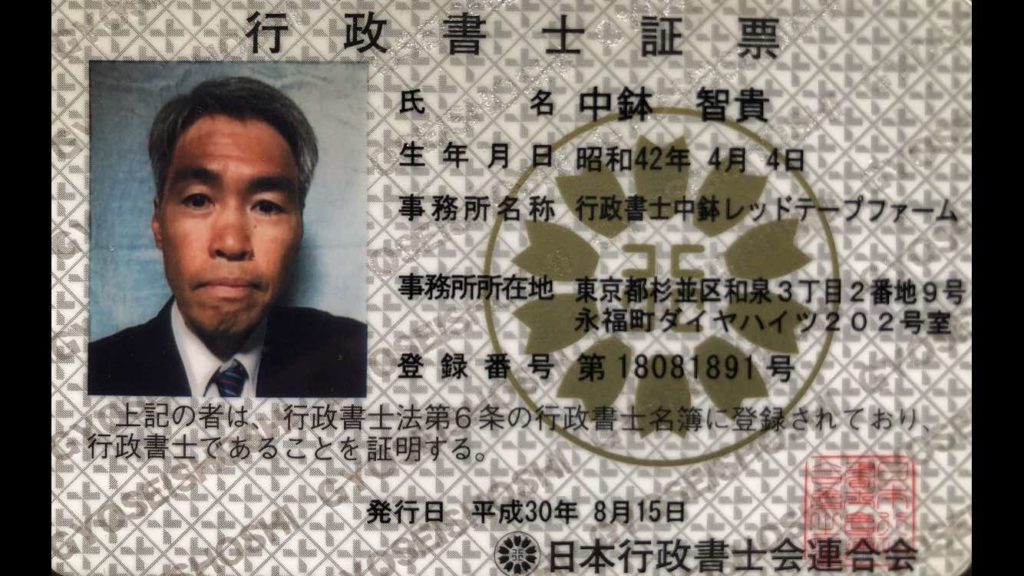
Tomotaka Nakabachi
A member of Tokyo Certified Administrative Procedures Legal Specialist Association
Registration Number: 18081891
Certified by Tokyo Regional Immigration Services Bureau: 行-132024200159